// Content production · Retro //
'90s low-poly, PS1 style
Novo9:16 · 29 s
Details3D scenes that look like a PlayStation 1 game: chunky pixels, jittery vertices, warping floor textures, dithered 15-bit color and fog. In 9:16 and 16:9.
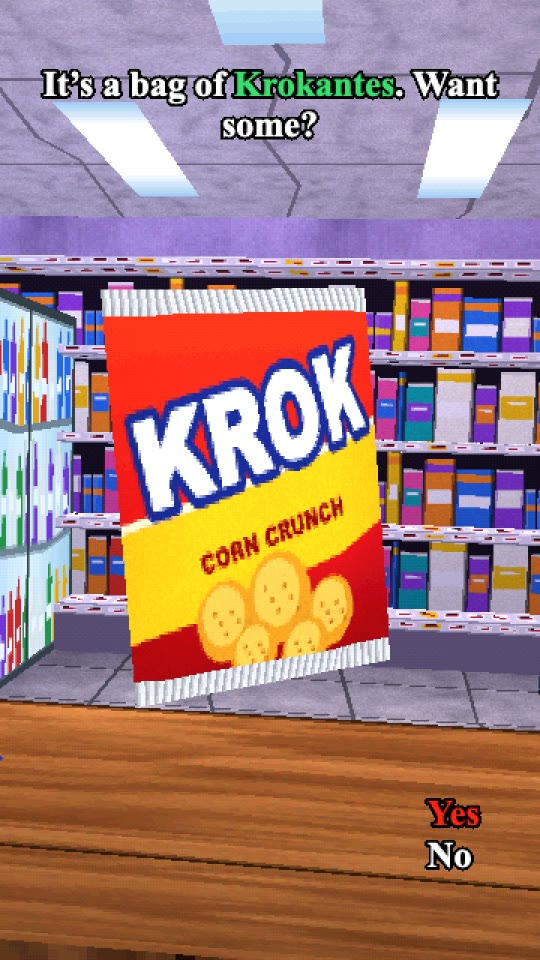
The look has three signatures. The console image: the scene is drawn at 270×480 and scaled up 4× without smoothing, so each pixel becomes a 4×4 block with stair-stepped edges; vertices snap to the pixel grid, and the geometry jitters when the camera moves; textures have no perspective correction and warp on the floor; and the final color is 15-bit, with dithering in the gradients. The material: tiny textures, 16 to 32 px, made in code and unfiltered, per-vertex lighting, no specular highlights, 1-bit transparency and depth fog instead of blur and shadows. And the world: the “test room” as the default set, a dithered gradient for scenes without a floor, everyday objects and rooms in cutaway, a neutral palette with a single accent and crisp captions on top of everything. The example video is a compilation of seven test scenes in the same console look, 29 seconds with no narration, made on a separate WebGL test bench rather than with the skill's own project: a bag of chips spinning on a store counter, with a game-style dialog box; four night scenes where the light does the work, a moving van behind a chain-link fence, a bar alley whose door light switches from red to blue, a fire burning in a barrel and a bottle glowing on a rooftop; and two on the beach, Alex turning in place and a kiosk with a scrolling LED sign. Alex was modeled for the test bench: in the skill, people are only a faceless figure seen from afar; an up-close character needs a rigged 3D model, which is outside the skill. What comes with the skill: the three.js library (low-face primitives, lathed and swept pieces for snakes, cables and hoses, textures, sky, captions and camera), five examples to start from (two in 9:16, a shower and a snake in cutaway, and three in 16:9: a square with sodium streetlights, a security camera and the evidence tape), the analog horror kit (vertex-baked lighting, streetlight, faceless figure, tape HUD with REC and timecode, and the evidence tape, which puts a real photo or video on a CRT TV, with the source on screen), a script that renders frame by frame and sound effects synthesized from markers in the code. Nothing comes from outside: geometry, textures and sky all come from code. Requirements: Node 20 or newer, ffmpeg, python3 (numpy and scipy only for the sound) and WebGL2 in Playwright's Chromium (on Mac, via Metal). No MCP or API needed. To install, unzip the .zip into ~/.claude/skills/.
- 9:16 · 29 s
- Runs in Claude Code
- Advanced
The look has three signatures. The console image: the scene is drawn at 270×480 and scaled up 4× without smoothing, so each pixel becomes a 4×4 block with stair-stepped edges; vertices snap to the pixel grid, and the geometry jitters when the camera moves; textures have no perspective correction and warp on the floor; and the final color is 15-bit, with dithering in the gradients. The material: tiny textures, 16 to 32 px, made in code and unfiltered, per-vertex lighting, no specular highlights, 1-bit transparency and depth fog instead of blur and shadows. And the world: the “test room” as the default set, a dithered gradient for scenes without a floor, everyday objects and rooms in cutaway, a neutral palette with a single accent and crisp captions on top of everything. The example video is a compilation of seven test scenes in the same console look, 29 seconds with no narration, made on a separate WebGL test bench rather than with the skill's own project: a bag of chips spinning on a store counter, with a game-style dialog box; four night scenes where the light does the work, a moving van behind a chain-link fence, a bar alley whose door light switches from red to blue, a fire burning in a barrel and a bottle glowing on a rooftop; and two on the beach, Alex turning in place and a kiosk with a scrolling LED sign. Alex was modeled for the test bench: in the skill, people are only a faceless figure seen from afar; an up-close character needs a rigged 3D model, which is outside the skill. What comes with the skill: the three.js library (low-face primitives, lathed and swept pieces for snakes, cables and hoses, textures, sky, captions and camera), five examples to start from (two in 9:16, a shower and a snake in cutaway, and three in 16:9: a square with sodium streetlights, a security camera and the evidence tape), the analog horror kit (vertex-baked lighting, streetlight, faceless figure, tape HUD with REC and timecode, and the evidence tape, which puts a real photo or video on a CRT TV, with the source on screen), a script that renders frame by frame and sound effects synthesized from markers in the code. Nothing comes from outside: geometry, textures and sky all come from code. Requirements: Node 20 or newer, ffmpeg, python3 (numpy and scipy only for the sound) and WebGL2 in Playwright's Chromium (on Mac, via Metal). No MCP or API needed. To install, unzip the .zip into ~/.claude/skills/.
How to use
01
Copy the prompt
Use the Copy prompt button on this page.
02
Paste it into your AI
Open Claude Code in the project folder and paste the prompt.
03
Get the video
Claude delivers an MP4 ready to post.
In the package
- Prompt ready to copy and paste
- Video in 9:16, 29 s
- Skill as a .zip to install in Claude