// Content production · Tech //
Low-poly Explainer
Data · 9:16 · 11 s
DetailsLow-poly clay 3D model on midnight blue, with a “how it works” HUD, cutaway and exploded view, labels that track the parts, and word-by-word captions.
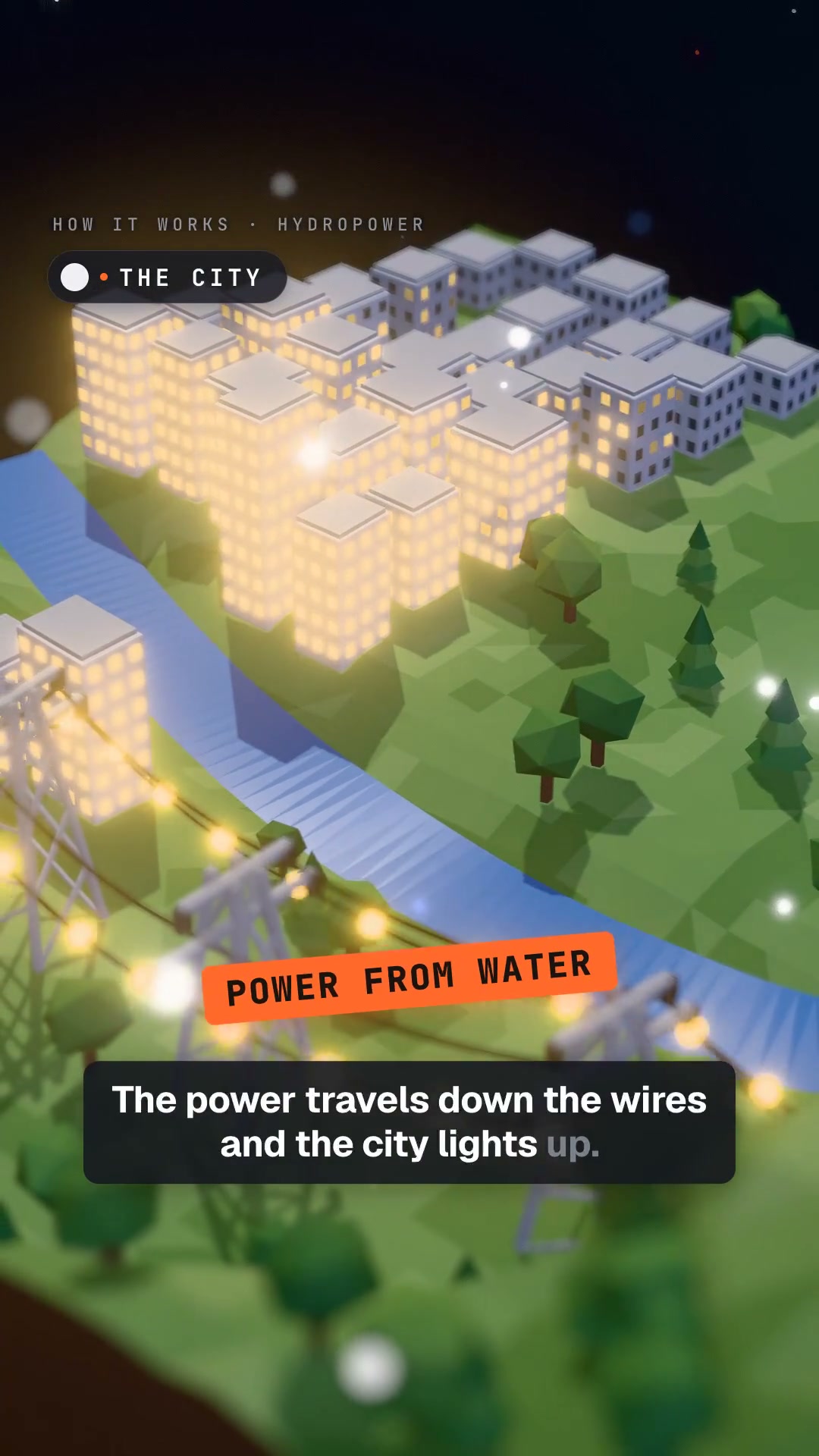
The look has three signatures. A low-poly clay 3D scale model, made of simple matte pieces, almost all white and gray with a single orange accent, floating in midnight blue with bokeh dust and strong depth of field, which gives it a miniature feel. A “how it works” HUD: a header in a spaced mono font, a pill chip with the chapter name, labels that track the parts with a thin leader line, dark panels, and a tilted orange stamp. And a caption that lights up word by word, from gray to white, with a camera that drives the explanation chapter by chapter, opens the model in a cutaway, and separates the parts in an exploded view. In the example, 11 seconds explain how a hydroelectric plant works: the dam holds back the river, the water drops through the penstock, pushes the turbine that spins the generator, and the power travels along the lines until the city lights up. The skill builds the model in three.js with a style library (terrain, water, trees, a city that lights up, towers, cables, pipes, turbine, generator, gears, cars, houses, and figures, plus boxes, cylinders, and spheres for new parts), with animated flows running through pipes and cables, renders frame by frame with Playwright and ffmpeg, and synthesizes the soundtrack and effects. It also includes a catalog with every part in the library in a single frame. Requirements: Node 20 or newer, ffmpeg, python3, and WebGL2 in Playwright's Chromium (on the Mac, through Metal).
- Data · 9:16 · 11 s
- Runs in Claude Code
- Advanced
The look has three signatures. A low-poly clay 3D scale model, made of simple matte pieces, almost all white and gray with a single orange accent, floating in midnight blue with bokeh dust and strong depth of field, which gives it a miniature feel. A “how it works” HUD: a header in a spaced mono font, a pill chip with the chapter name, labels that track the parts with a thin leader line, dark panels, and a tilted orange stamp. And a caption that lights up word by word, from gray to white, with a camera that drives the explanation chapter by chapter, opens the model in a cutaway, and separates the parts in an exploded view. In the example, 11 seconds explain how a hydroelectric plant works: the dam holds back the river, the water drops through the penstock, pushes the turbine that spins the generator, and the power travels along the lines until the city lights up. The skill builds the model in three.js with a style library (terrain, water, trees, a city that lights up, towers, cables, pipes, turbine, generator, gears, cars, houses, and figures, plus boxes, cylinders, and spheres for new parts), with animated flows running through pipes and cables, renders frame by frame with Playwright and ffmpeg, and synthesizes the soundtrack and effects. It also includes a catalog with every part in the library in a single frame. Requirements: Node 20 or newer, ffmpeg, python3, and WebGL2 in Playwright's Chromium (on the Mac, through Metal).
How to use
01
Copy the prompt
Use the Copy prompt button on this page.
02
Paste it into your AI
Open Claude Code in the project folder and paste the prompt.
03
Get the video
Claude delivers an MP4 ready to post.
In the package
- Prompt ready to copy and paste
- Video in 9:16, 11 s
- Skill as a .zip to install in Claude